
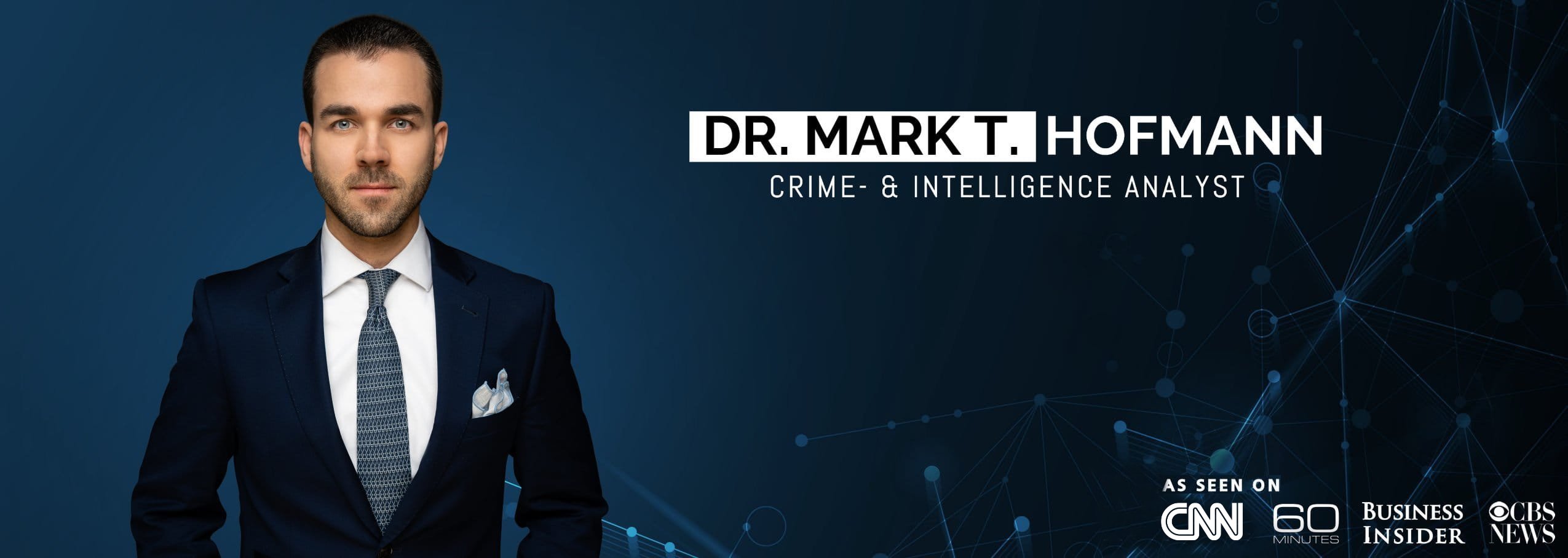
“Dr. Darknet”
Cybersecurity Expert on the Psychology of Cybercrime
Dr. Hofmann about Darknet-Research, Cyber-Profiling and the Psychology of Hackers
Dr. Mark T. Hofmann is a Crime- and Intelligence Analyst. He earned his doctorate in psychology, magna cum laude, at the University of Tübingen with research on the profiles and motives of hackers. He conducted scientific interviews with hackers to understand their inside perspective. Known as “Dr. Darknet”, he has appeared on international TV and streaming formats (CNN, ARD, Forbes, RTL, CBS, 60 Minutes Australia and many more).
As a Cybersecurity Expert and speaker, he shows companies and government agencies worldwide how to decode attackers’ motives and protect themselves effectively against AI and cyber threats.
His clients include companies of every size, global corporations, government agencies, universities and banks.
On this page, you will find selected insights from Dr. Hofmann’s experience and his own darknet research.
Profiling: Inside the Mind of Hackers
Dr. Mark T. Hofmann reports on his research into hackers on the dark web and their psychological justification mechanisms. In his Moral Disengagement Theory, Albert Bandura described the principle of “advantageous comparison.” This involves pointing to others who commit even worse acts in order to make one’s own behavior appear in a morally better light. On the dark web in particular, it is easy to repeatedly find others whose behavior is perceived as even more reprehensible.
Psychology of Cybercrime: The Dark Triad
What drives people to hack, and what role does their personality play? In this video, Cyber-Profiler Dr. Hofmann discusses his research on hacking in relation to the Dark Triad of personality: Narcissism, Psychopathy, and Machiavellianism. Criminal Black Hat Hackers are more psychopathic and machiavellian than White Hat Hackers, who use their skills to improve cybersecurity. The role of Narcissism is more complex.
Profiling Hackers: The Motives
Many hackers possess such rare skills that they could earn a lot of money even on the “good side” or as startup founders. Those who have these alternatives and still choose a criminal path are not driven solely by money. Key motivations include the Challenge, the thrill (the rush, the adrenaline), as well as fun, trolling behavior, and feelings of power. About one-third of the participants also cited “feelings of addiction” as a category of motivation.
Crime Prevention: How Kids become Hackers
Europol reports: “Teenager suspected of leading the KillSec ransomware group”. Most hackers begin learning to hack at around 10 to 15 years of age. In this video, Dr. Mark T. Hofmann explains the basic radicalization process, – how children can become hackers and what preventive measures are effective. Key factors in this process include the desire for a challenge, YouTube algorithms, and modding or cheating in video games.
Hacker Profiles and the Dark Economy
On Netflix, Amazon Prime, and in TV shows, hackers are often stereotypically portrayed as 15-year-old teenagers wearing Anonymous masks and black hoodies. This is not a realistic depiction of how most ransomware groups actually operate. According to Statista, global losses from cybercrime could reach approximately 11.36 trillion USD by 2026. If cybercrime were a country with GDP, it would be the third-largest economy in the world after the U.S. and China. The BKA is therefore right to refer to it as an “underground economy.”
The Online Disinhibition Effect
The Online Disinhibition Effect describes the tendency to say or do things in the digital space that one would not say or do in real life. This disinhibition can also apply to positive aspects – such as dating: Messaging someone online is easier than approaching them in person. However, the internet can also lead to disinhibition when it comes to hate speech, cyberbullying, or cybercrime. Cybersecurity Expert Dr. Hofmann views the effect as a disinhibiting factor (similar to alcohol) but rejects it as a monocausal explanation for cybercriminal behavior.
No Stereotyping
Hackers are often categorized as “Black Hats,” “White Hats,” and “Gray Hats.” While Black Hats act without authorization and criminally for their own gain, White Hats use their skills in the service of cybersecurity, for example, by identifying security vulnerabilities on behalf of companies. Gray Hats, or “hacktivists”, operate in a gray area between these two worlds. In this video, Darknet Expert Dr. Hofmann explains why these categories are less distinct in reality than they appear at first glance.
Live-Profiling of a Hacker
In the U.S., Dr. Mark T. Hofmann met a Gray Hat Hacker who exclusively targets criminal hackers and scammers without seeking personal gain. Dr. Hofmann presented him with three variations of the well-known “trolley problem”, a classic ethical dilemma, to explore his moral decision-making principles as part of a “live profiling” exercise. Through his direct research with hackers, Cybersecurity Expert Dr. Mark T. Hofmann has unique insight into the thought processes and behavior of cybercriminals and is therefore considered one of the top keynote speakers on artificial intelligence (threats/deepfakes) and one of the top cybersecurity speakers: He presents cybersecurity, AI threats, and his own darknet research in a clear and accessible manner.